
The thing that ends a New Zealand real estate career usually isn’t fraud. It’s blanks.
I spent a morning this week reading one disciplinary file that ran six decisions across fourteen months. Two committees. Two appeals. Most of it was the system arguing with itself. The part that actually mattered took about thirty seconds to understand, and it’s the cleanest argument for building software in this space that I’ve come across.
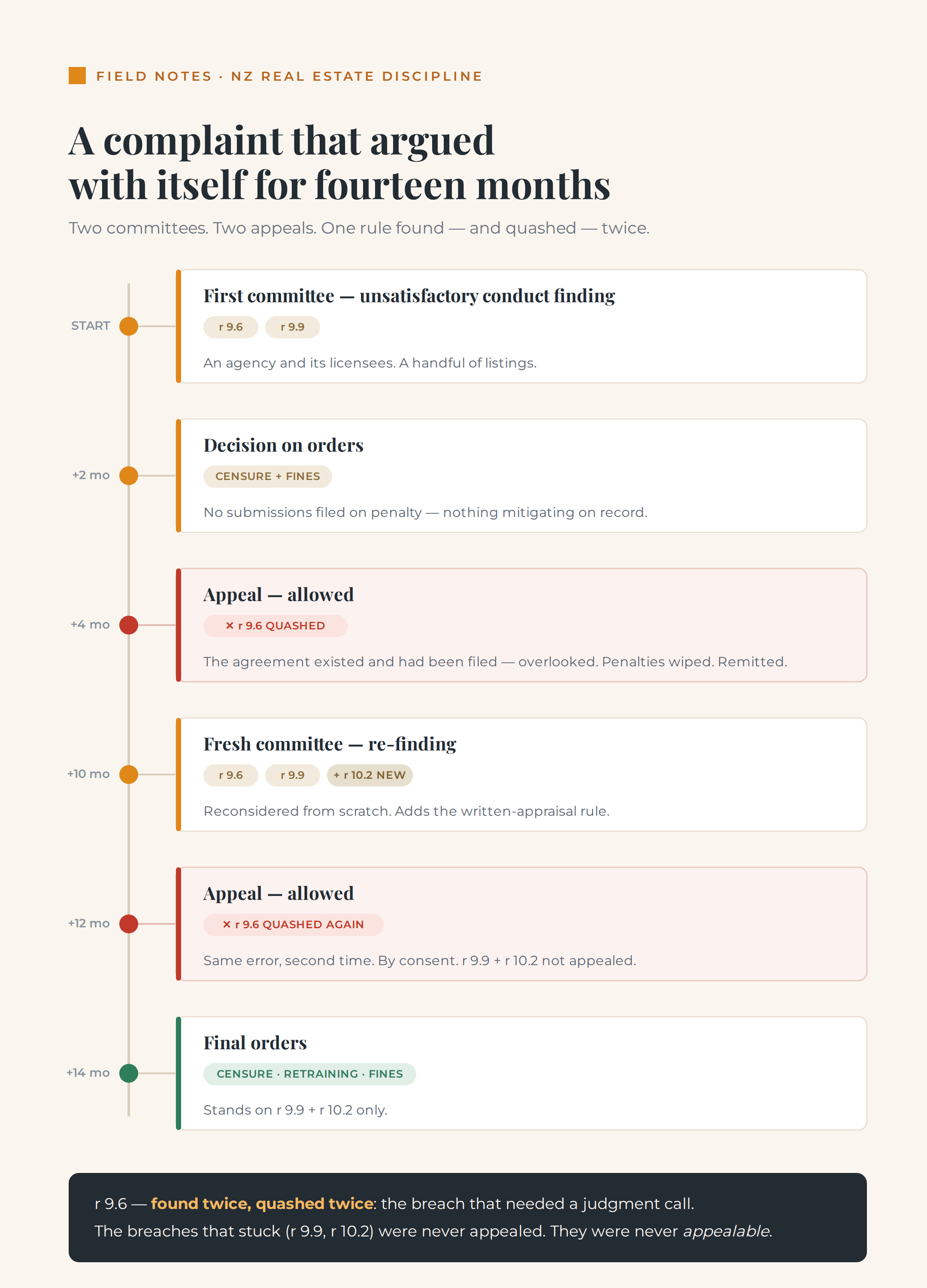
Here’s the whole arc.
The audit
An Authority investigator walks into an office and pulls its listings. The website shows more salespeople than the records say are licensed there, so the listings get a look.
Many aren’t current. Of the ones that are, the agency agreements have been signed by vendors with large chunks of information left blank — including the disclosure questions. Some listings have no written appraisal on file at all.
Nothing exotic. Just gaps.
The first finding
The first committee found the agency and its licensees guilty of unsatisfactory conduct — that’s the s 89(2)(b)determination under the Real Estate Agents Act 2008, meaning it’s been proved on the balance of probabilities. The committee pinned it on two rules from the Professional Conduct and Client Care Rules 2012:
Rule 9.6 — Unless authorised by a client through an agency agreement, a licensee must not offer or market any land or business, including by putting details on any website or by placing a sign on the property.
Rule 9.9 — A licensee must not submit an agency agreement, sale and purchase agreement, or other contractual document to any person for signature unless all material particulars have been inserted into or attached to the document.
Then came the orders, under s 93 (the committee’s power to make orders once unsatisfactory conduct is found): a censure for all parties, plus fines. Nobody filed submissions on penalty, so the committee had nothing mitigating to weigh. Bad conduct, no defence on record.
The twist
One licensee appealed. Under s 111, an appeal to the Disciplinary Tribunal is by way of rehearing, not a narrow review. But they appealed exactly one thing: the r 9.6 finding on a single property.
The point was simple. There was an agency agreement for that listing. It had been handed to the Authority. The committee just hadn’t looked at it.
The Authority agreed. The Tribunal quashed the r 9.6 finding — and, as a matter of fairness, quashed it for the other parties who hadn’t even appealed. The penalty orders went with it. The whole thing was remitted to a fresh committee.
Round two — same mistake
A new committee reconsidered it from scratch. It re-found unsatisfactory conduct — and this time added a rule the first decision never cited:
Rule 10.2 — An appraisal of land or a business must (a) be provided in writing to a client; (b) realistically reflect current market conditions; and (c) be supported by comparable information on sales of similar land in similar locations or businesses.
So now the finding rested on r 9.6 + r 9.9 + r 10.2.
The licensee appealed again. Only r 9.6, again. And the Authority conceded — again — that agency agreements were in place. The Tribunal allowed the appeal by consent. r 9.6 was quashed a second time.
They did not appeal r 9.9. They did not appeal r 10.2. They couldn’t, really.
What it cost
The final orders: censure for all parties; mandatory retraining in contract and agency law; and fines across the agency and both licensees. All of it standing on r 9.9 and r 10.2 alone.
The part worth sitting with
r 9.6 was found twice and reversed twice — on the identical error. A committee looked at a file, didn’t see the agreement that was sitting in it, and recorded a breach for marketing-without-authority that never happened. Then a second committee did the same thing.
Meanwhile r 9.9 and r 10.2 never moved. The agreements were signed with the material particulars blank. There was no written appraisal. Those aren’t matters of interpretation — they’re matters of fact, visible on the face of the document.
That’s the whole split. r 9.6 is the breach that required a judgment call — does an agreement exist, is it in force, is it the right one — and judgment, under audit pressure, is exactly where humans make mistakes. Twice, in this file. r 9.9 and r 10.2 are deterministic. A blank field is a blank field. A missing appraisal is missing or it isn’t.
The agent didn’t lose because the committee got r 9.6 wrong. They lost because the boring questions had boring answers, and nobody asked them in time.
Why I’m building Resaido
Every breach that survived this file is checkable at the point of listing, before anything goes wrong:
r 9.9 — is every material particular filled in before this agreement goes for signature?
r 10.2 — is there a written appraisal on file, dated, with comparables?
r 9.6 — is there a current agency agreement in place before the first photo hits the website?
Three yes/no questions. The failures here — and in most of the disciplinary record I’ve read — are just those questions, unanswered, discovered too late by an investigator instead of caught early by the agent.
That’s not a legal problem. It’s a tooling problem. The rules are deterministic, the failures are predictable, and the software to catch them at the moment of listing mostly doesn’t exist yet. So I’m building it. Resaido is compliance memory for agents — it reads the agreement before the vendor signs, not after the audit. A pre-mortem, not a post-mortem.
A committee found the wrong breach twice. That’s the part everyone remembers. But the lesson isn’t about the committee. It’s that the things most likely to end your career are the things most boring to check — which makes them the easiest things in the world to check for you, automatically, every time.
Building Resaido in public. Notes on NZ real estate compliance, legal-AI, and what the disciplinary record actually teaches. — @ellenbuilds